Choosing the right pharmacy course after your 12th standard is a pivotal decision that defines your trajectory within the healthcare ecosystem. With the pharmaceutical industry evolving rapidly through biotechnology and personalized medicine, understanding your options is more critical than ever.
In this comprehensive guide, we break down the three primary pathways—D.Pharm, B.Pharm, and M.Pharm—comparing eligibility, costs, and career outcomes to help you make an informed choice for 2026.
At a Glance: Pharmacy Course Overview
The pharmacy hierarchy is designed to cater to different professional needs, from retail operations to high-level clinical research.
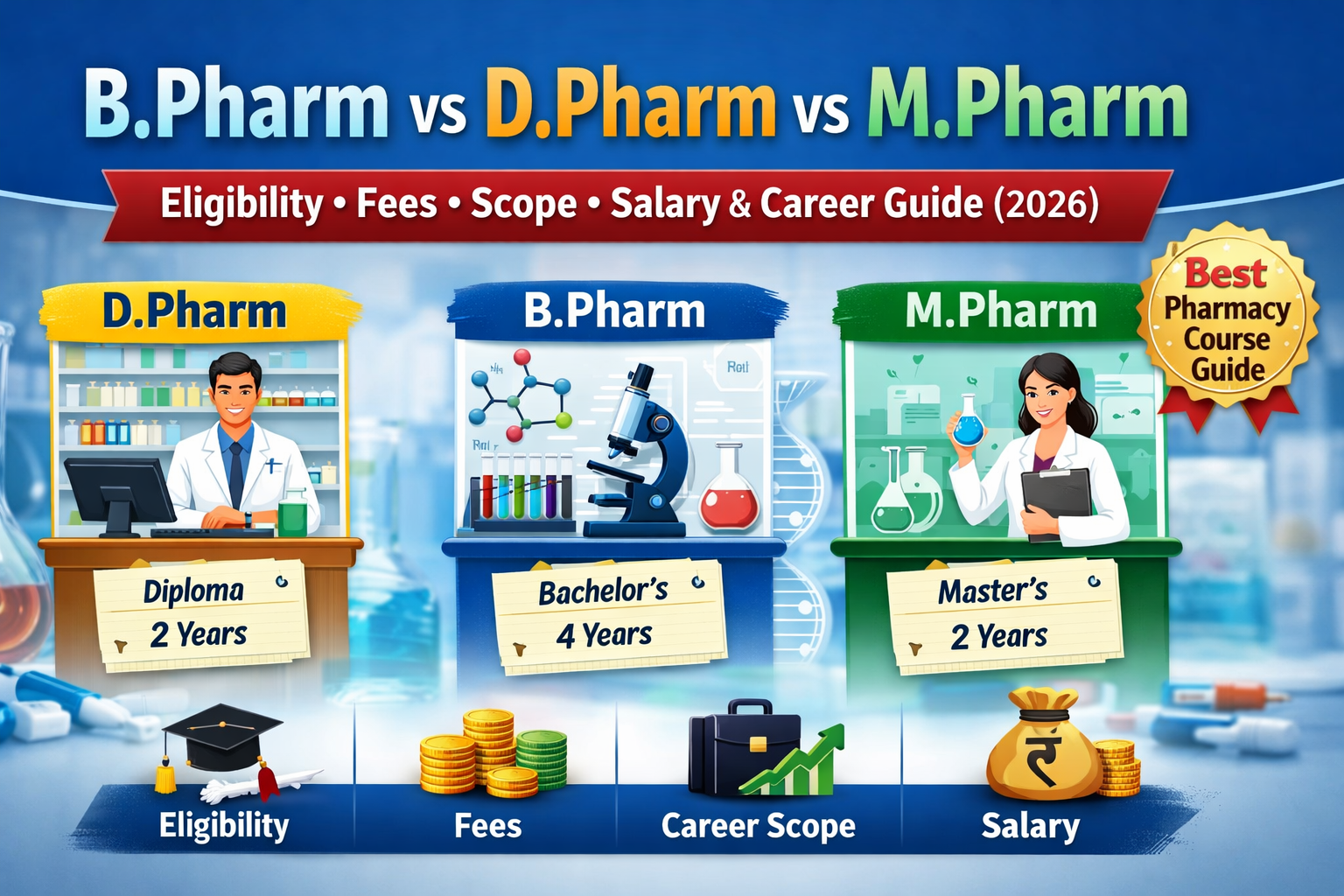
D.Pharm (Diploma in Pharmacy): A 2-year foundational program focused on the practical aspects of medicine dispensing.
B.Pharm (Bachelor of Pharmacy): A 4-year undergraduate degree that offers a deep dive into the science of drug synthesis and industry operations.
M.Pharm (Master of Pharmacy): A 2-year postgraduate specialization for those aiming for leadership or research roles.
Eligibility & Admission Requirements
To enter the field of pharmacy, you must have a strong foundation in science. Here is what you need to qualify:
D.Pharm (Diploma)
Education: 10+2 with Physics, Chemistry, and either Biology or Mathematics.
Minimum Marks: Typically 45–50% aggregate.
B.Pharm (Bachelor’s)
Education: 10+2 with PCB (Biology) or PCM (Mathematics).
Minimum Marks: 50% aggregate.
Selection: Admission is often based on state-level or national entrance exams (e.g., WBJEE, MHT-CET, or NEET in some regions).
M.Pharm (Master’s)
Education: Completion of a B.Pharm degree from a recognized institution.
Entrance Exams: Requires a valid GPAT (Graduate Pharmacy Aptitude Test) score or university-specific entrance exams.
Course Fees in India
The cost of education varies significantly between government-aided and private institutions.
| Course | Average Total Fees (Approx.) |
| D.Pharm | ₹50,000 – ₹1.5 Lakh |
| B.Pharm | ₹2 Lakh – ₹6 Lakh |
| M.Pharm | ₹2 Lakh – ₹5 Lakh |
What You Will Learn: Course Structure
Each level of study shifts the focus from basic application to complex innovation.
D.Pharm: The Practical Route
The curriculum is designed for those who want to enter the workforce quickly. It focuses on:
Medicine dispensing and storage.
Basic pharmacology and toxicology.
Practical training in hospital pharmacies.
B.Pharm: The Industry Standard
This is a holistic program that prepares you for the corporate and clinical world:
Pharmacognosy: The study of medicines from natural sources.
Pharmaceutics: The process of turning a new chemical entity into a medication.
Internships: Mandatory industry exposure.
M.Pharm: The Expert Specialization
Here, you choose a niche, such as Pharmaceutics, Pharmacology, or Quality Assurance. The focus is on:
Advanced research methodologies.
Thesis and clinical trials.
Regulatory affairs and global standards.
Career Opportunities & Salary Scope
Your choice of course determines your ceiling in the professional world.
Career Paths
After D.Pharm: Community Pharmacist, Hospital Pharmacy Assistant, or Entrepreneur (owning a retail medical store).
After B.Pharm: Drug Inspector, Quality Control Analyst, Medical Representative (Sales), or Production Manager.
After M.Pharm: Research Scientist, Associate Professor, Regulatory Affairs Specialist, or Clinical Research Associate (CRA).
Salary Expectations (Annual)
D.Pharm: ₹2.0 – ₹3.5 LPA (Entry-level)
B.Pharm: ₹3.0 – ₹6.0 LPA
M.Pharm: ₹4.0 – ₹10.0+ LPA (Varies by specialization and industry)
Side-by-Side Comparison
| Feature | D.Pharm | B.Pharm | M.Pharm |
| Duration | 2 Years | 4 Years | 2 Years |
| Level | Diploma | Degree | Post-Graduation |
| Global Validity | Limited | High | Very High |
| Career Growth | Moderate | High | Excellent |
Which Course is Right for You?
Choose D.Pharm if: You want to start working as soon as possible, have a limited budget, or plan to manage a family-owned pharmacy.
Choose B.Pharm if: You want a versatile career with opportunities in manufacturing, marketing, and government jobs. It is the gold standard for most pharmacy aspirants.
Choose M.Pharm if: You have a passion for research, want to work in top-tier R&D labs, or aspire to teach at the university level.
Final Verdict
If you are looking for the most balanced path, B.Pharm is the best overall option, providing the flexibility to work immediately or pursue higher studies. However, for long-term success and high-paying global roles, a combination of B.Pharm + M.Pharm remains the most powerful credential in the healthcare industry.
Frequently Asked Questions (FAQs)
Q1. Can I pursue M.Pharm directly after a D.Pharm?
No. You must complete a B.Pharm degree (often via “Lateral Entry” into the 2nd year of B.Pharm) before you can apply for M.Pharm.
Q2. Which course offers the highest starting salary?
M.Pharm graduates, particularly those in Research or Regulatory Affairs, generally command the highest starting salaries.
Q3. Is B.Pharm better than D.Pharm for abroad opportunities?
Yes. Most international licensing bodies (like those in the US, UK, or Canada) require a minimum of a 4-year Bachelor’s degree for pharmacist registration.